What Is Technical Debt?
Last updated . Sources are named and dated inline - how we source claims.
The comprehensive guide to understanding technical debt: from Ward Cunningham's original metaphor to real-world examples across JavaScript, Java, .NET, and Python

"Shipping first time code is like going into debt. A little debt speeds development so long as it is paid back promptly with a rewrite... The danger occurs when the debt is not repaid. Every minute spent on not-quite-right code counts as interest on that debt. Entire engineering organizations can be brought to a stand-still under the debt load of an unconsolidated implementation."- Ward Cunningham, 1992 (OOPSLA Experience Report)
Ward Cunningham coined the term "technical debt" in 1992 to explain to his boss why they needed to refactor their financial software. The metaphor was brilliant: everyone understands financial debt - borrow money now, pay interest until you repay the principal. Technical debt works the same way: take shortcuts now, pay "interest" in slower development and more bugs until you "repay" through refactoring.
The Definition
Technical debt is the implied cost of future rework caused by choosing an expedient solution now instead of a better approach that would take longer.
The Principal
The work you'll eventually need to do to properly fix the shortcut (refactoring, rewriting, updating dependencies)
The Interest
The ongoing pain: slower feature development, more bugs, harder onboarding, increased complexity, developer frustration
How Technical Debt Works: The Life of One Shortcut
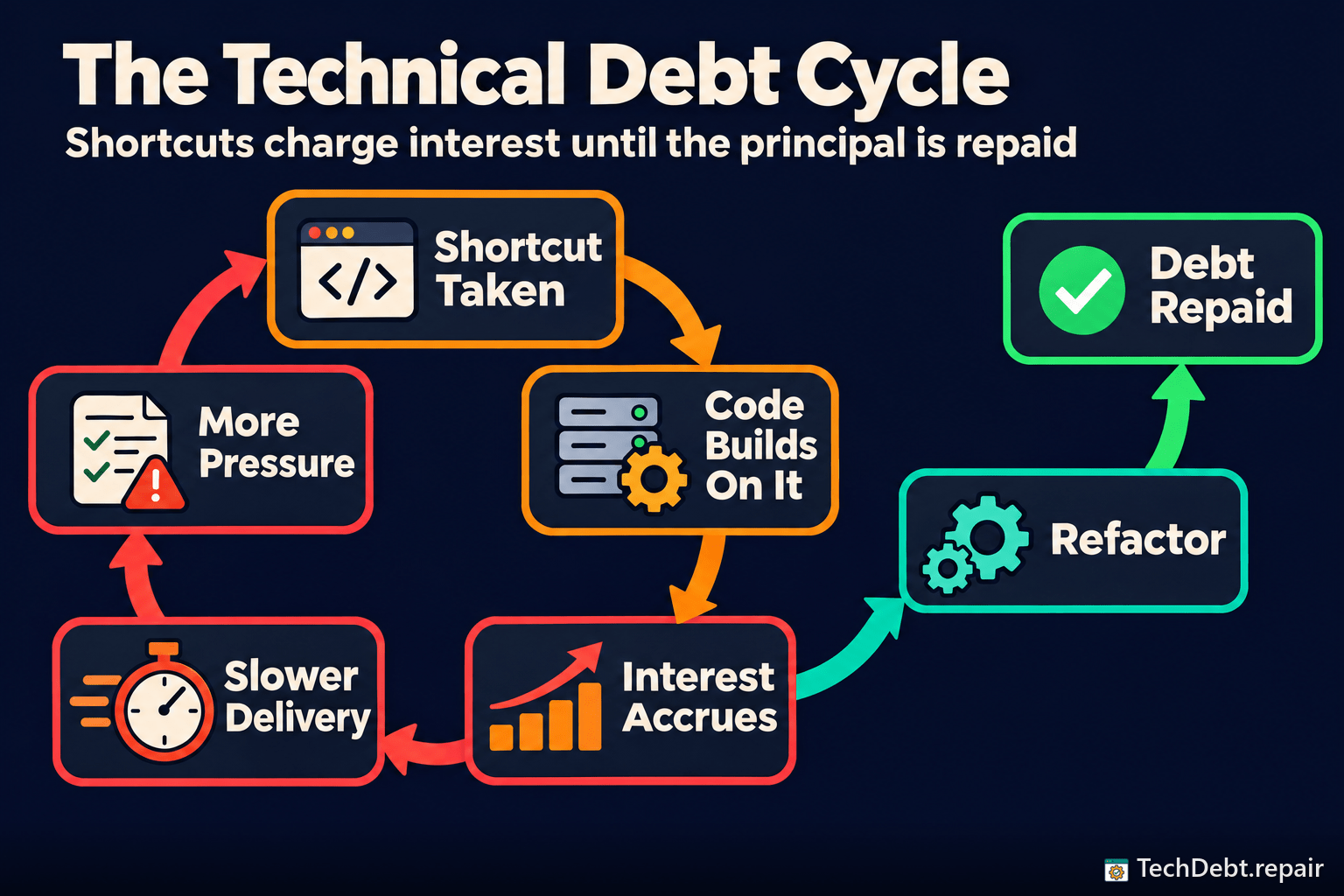
Principal and interest are easier to understand when you follow a single shortcut from the day it is taken to the day it is repaid. The walkthrough below is an illustrative example, not a record of a real team: a product group hardcodes a single currency into its checkout code to make a launch date.
Step 1: The Shortcut Is Taken
The team knows prices should flow through a currency-aware money type, but building one would miss the launch. They store every price as a plain number and assume one currency everywhere. This is the moment of borrowing. The time saved is real, and so is the obligation: the principal is the work of introducing a proper money type later.
Step 2: New Code Builds On It
Nothing stands still around a shortcut. Invoices, refunds, reports, and discount rules are all written against the plain-number price, and each one quietly copies the single-currency assumption. Nobody made a second bad decision, yet the principal has grown, because repaying it now means changing every place that leaned on the original choice.
Step 3: Interest Shows Up in Everyday Work
The business asks for a second currency. A request that sounds small turns into a hunt through every module that touches a price. Estimates get padded, rounding defects appear in places nobody expected, and new hires need the history explained before they can change anything safely. None of this is repayment. It is interest: effort spent because of the shortcut that leaves the shortcut exactly where it was.
Step 4: Pressure Invites More Borrowing
Slower delivery creates schedule pressure, and pressure is exactly what produced the first shortcut. The tempting move is a second one: a special case for the new currency bolted onto checkout, with a promise to tidy up later. Now there are two debts, and the second is stacked on the first. This loop is why debt left alone tends to accelerate rather than hold steady.
Step 5: Repay the Principal or Keep Paying
The exit is the rewrite Cunningham described: introduce the money type, move one module at a time onto it, and delete the special cases. After that, a third currency is configuration instead of a project. The interest stops because the cause is gone, not because the team learned to live with it. The practical ways to do this are covered in reduction techniques.
What to take from the walkthrough: the shortcut itself was reasonable. The damage came from the gap between Step 1 and Step 5. Cunningham's own wording carries the condition - debt helps "so long as it is paid back promptly."
The Real Cost: Industry Data
Accumulated technical debt held by US companies, reported alongside a $2.41 trillion total cost of poor software quality
Source: CISQ, The Cost of Poor Software Quality in the US: A 2022 Report
Of a 41.1-hour week spent on technical debt rather than building features, inside 17.3 hours of maintenance overall
Source: Stripe, The Developer Coefficient, 2018
Saw technical debt as their biggest challenge heading into 2024, the most recent CTO survey to put a number on it
Source: STX Next, 2023 Global CTO Survey, as reported by Intelligent CIO, November 2023
Three figures, three named publishers, three dated reports. Numbers that could not be traced back to a specific publication have been removed from this page rather than re-attributed to a plausible-sounding one - see research and citations for the standard.
Martin Fowler's Technical Debt Quadrant
Not all technical debt is created equal. Martin Fowler categorized debt along two dimensions: Reckless vs. Prudent and Deliberate vs. Inadvertent.
Reckless & Deliberate
Attitude: "We don't have time for design!"
Ignoring good practices under pressure. Skipping tests, ignoring architecture, copy-pasting without thinking.
Example: Hardcoding credentials directly in source code to ship faster, knowing it's a security risk.
Reckless & Inadvertent
Attitude: "What's layering?"
Lack of knowledge about best practices. Junior developers or teams unfamiliar with the domain creating messy code unintentionally.
Example: Creating a 2000-line "god class" because you don't know about separation of concerns.
Prudent & Deliberate
Attitude: "We must ship now and deal with consequences."
Conscious trade-offs with a clear repayment plan. Strategic decisions to move fast with eyes wide open.
Example: Using a monolith architecture for MVP, planning to break into microservices after product-market fit.
Prudent & Inadvertent
Attitude: "Now we know how we should have done it."
Learning better approaches through experience. You did your best at the time, but now you know better.
Example: Building a feature, then realizing a week later a different pattern would scale better.
Key Insight: Prudent & Deliberate debt can be strategic. The other three quadrants should be avoided or remediated quickly. The worst is Reckless & Deliberate - knowingly making bad decisions without planning to fix them.
Before You Borrow: How to Take On Debt Deliberately
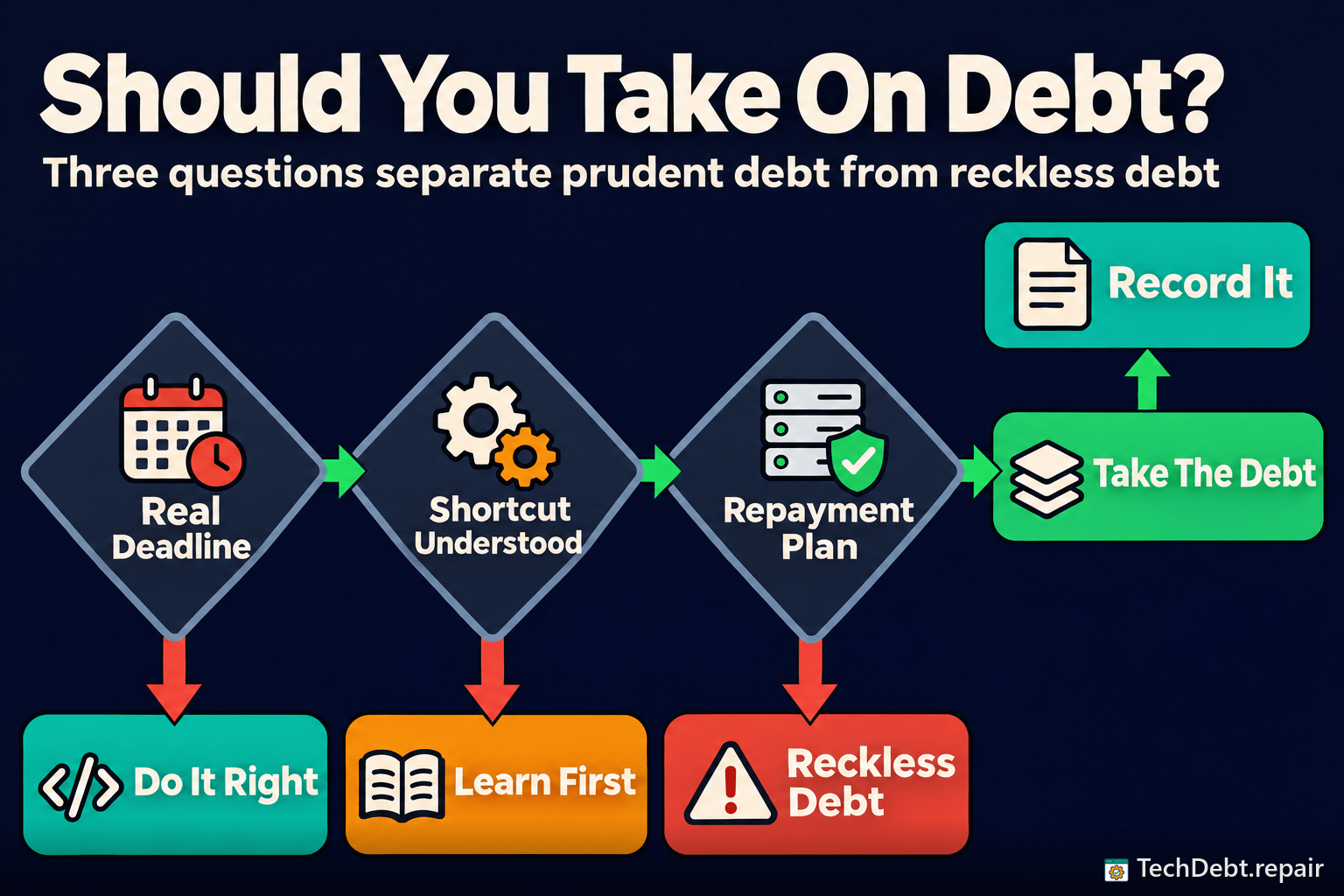
The quadrant describes debt after the fact. The more useful moment is before the shortcut is taken, when a team can still choose which quadrant it lands in. Three questions, asked in order, do most of the sorting.
Is the Deadline Real?
A launch tied to a contract, a regulatory date, or a test of whether anyone wants the product is a reason to borrow. A date that exists only because someone wrote it on a slide is not. If nothing of value is lost by taking the longer path, take the longer path.
Do You Understand the Shortcut?
Deliberate debt requires knowing what the better design would have been and what the cheaper one gives up. If the team cannot describe the proper solution, it is not choosing a trade-off, it is guessing. Spend a short time learning first, or the debt lands on the inadvertent side of the quadrant.
Is There a Repayment Plan?
"We will clean it up later" is a hope, not a plan. A plan names the event that triggers repayment, the person who owns it, and roughly what the work involves. Without those, a prudent decision turns reckless the day the people who made it move on.
What to Record When You Do Borrow
Debt that is written down stays a business tool. Debt that lives only in someone's memory becomes a surprise. A short note in the backlog or next to the code is enough, as long as it answers these points:
- The shortcut: what was done, and what the proper version would have been.
- The reason: the deadline or unknown that made borrowing worthwhile.
- The expected interest: which future changes will be slower or riskier because of it.
- The trigger: the event that means it is time to repay, such as a second customer type or a traffic threshold.
- The owner: a named team, so the note does not become an orphan.
- The blast radius: the modules that now depend on the shortcut, updated as that list grows.
Categories of Technical Debt
Code Debt
Poor code quality, inconsistent patterns, lack of readability, duplication, high complexity.
Examples: 500-line functions, copy-pasted code blocks, cyclomatic complexity over 20, variables named x, temp, data
Architecture Debt
System design that lacks scalability, flexibility, or maintainability. Antipatterns like circular dependencies and "spaghetti architecture."
Examples: Tight coupling between modules, no separation of concerns, business logic in UI layer, monolith when microservices needed
Infrastructure Debt
Outdated platforms, unsupported dependencies, manual deployment processes, lack of monitoring.
Examples: Running Node.js 20 (left support April 2026), Oracle Java 8 without a paid support contract (no free public updates for commercial use since January 2019), Python 3.10 (end of life October 2026), manual server provisioning, no CI/CD pipeline
Test Debt
Lack of automated tests, poor test coverage, brittle tests, no integration or E2E testing.
Examples: 20% code coverage, all tests are manual, tests break with every refactor, no testing for edge cases
Documentation Debt
Missing, outdated, or incomplete documentation for code, APIs, architecture, or deployment.
Examples: No README, API docs from 2019, architecture diagrams don't match reality, zero inline comments
Process Debt
Inefficient development processes, lack of code reviews, no version control practices, manual workflows.
Examples: No code review process, deploying directly to production, no branching strategy, release takes 3 days
AI-Generated Debt
NEW 2026Code generated by AI assistants (Copilot, Claude Code, Cursor, Devin) that works but introduces subtle quality, security, or architectural problems. The speed of AI generation makes this category compound faster than any other.
Examples: Accept-without-review AI suggestions, hallucinated dependencies, inconsistent architecture across AI-generated modules, verbose boilerplate that "looks right" but misses edge cases, AI tests that only cover happy paths
Debt Category Breakdown by Typical Cost
| Debt category | Cost index |
|---|---|
| Architecture | 95 |
| AI-Generated | 82 |
| Infrastructure | 75 |
| Code | 60 |
| Test | 50 |
| Process | 40 |
| Documentation | 25 |
Relative remediation cost by category (higher = more expensive to fix)
How to Tell Technical Debt From Its Look-Alikes
"Technical debt" gets used as a label for anything engineers wish were different. That weakens the term right when you need it in a budget conversation. Real debt has two parts you can point to: a cheaper choice that was made, and an ongoing cost that choice keeps charging. If either part is missing, you are looking at something else, and it needs a different response.
| What you are looking at | Is it technical debt? | How to tell | Better response |
|---|---|---|---|
| A feature the product does not have yet | No | Nothing existing is harder to change because of it. It is unbuilt scope. | Prioritize it on the product roadmap like any other feature. |
| Old code that is stable and rarely touched | Usually not | Age is not interest. If nobody has to change it and its platform is still supported, it charges almost nothing. | Leave it alone and watch the support dates of what it runs on. |
| Code written in a style you would not have chosen | No | It is consistent, tested, and others change it without trouble. The cost is taste, not time. | Agree on a team standard for new code and move on. |
| A simple design that fits today's needs | No | Nothing was cut. The design is complete for the problem that exists, and extending it later is ordinary work. | Keep it simple until a real requirement says otherwise. |
| A workaround everyone must remember to step around | Yes | A cheaper choice was made, and every related change now pays extra for it. | Record it, estimate the principal, and schedule repayment. |
| A runtime or library past its end-of-support date | Yes | Skipping upgrades was the cheaper choice. The interest is missing security fixes and blocked dependency updates. | Plan the upgrade before the next forced one arrives. |
| Generated code merged without anyone understanding it | Yes | Skipping review was the cheaper choice. The interest arrives the first time someone has to debug it. | Review it as if a new hire wrote it, then trim what is not needed. |
Warning Signs You Are Already Paying Interest
Debt rarely announces itself in the code. It shows up in how the work feels. If several of these describe your team, the interest payments have started, whether or not anyone has named the debt.
Estimates Come With a Warning
"It depends what we find in there" is attached to every estimate, and similar tasks take wildly different amounts of time depending on which module they touch.
Some Files Are Off Limits
There are parts of the system people route around rather than change, and only one or two engineers are trusted to open them.
Fixes Break Something Else
A change in one area causes a defect in an unrelated one, which tells you the two areas are coupled in ways nobody intended or documented.
Releases Are an Event
Shipping needs a checklist, a quiet period, and a particular person in the room. Teams ship less often because each release hurts.
Onboarding Runs on Folklore
New engineers learn the system from stories about why things are the way they are, because the documents and the code no longer agree.
Nobody Can Explain the Generated Parts
Reviews wave through boilerplate bloat because it looks plausible, and the same helper exists in several slightly different versions. That is how AI slop turns into fragile code.
Next step: signs tell you debt exists, not how much. To put a number on it, see the measurement frameworks or run the Tech Debt Calculator.
Real-World Examples by Language
JavaScript: Callback Hell
Before Promises and async/await, nested callbacks created "pyramid of doom" code that's nearly impossible to maintain or test.
// Callback hell - nested, hard to read, error handling nightmare
getUserData(userId, function(err, user) {
    if (err) {
        console.log(err);
        return;
    }
    getOrders(user.id, function(err, orders) {
        if (err) {
            console.log(err);
            return;
        }
        getOrderDetails(orders[0].id, function(err, details) {
            if (err) {
                console.log(err);
                return;
            }
            processPayment(details.total, function(err, result) {
                if (err) {
                    console.log(err);
                    return;
                }
                sendEmail(user.email, result);
            });
        });
    });
});// Modern async/await - readable, maintainable, clear error handling
async function processUserOrder(userId) {
try {
const user = await getUserData(userId);
const orders = await getOrders(user.id);
const details = await getOrderDetails(orders[0].id);
const result = await processPayment(details.total);
await sendEmail(user.email, result);
return result;
} catch (error) {
logger.error('Order processing failed:', error);
throw new OrderProcessingError(error);
}
}Impact: Callback hell increases bug rates by 3x and makes debugging take 5x longer. Refactoring to async/await improves code readability and reduces error-handling complexity.
Python: The Python 2 to 3 Split (Historical Example)
Python 2 reached end of life on January 1, 2020, so this is a historical cautionary tale rather than a live deadline. It earns its place because the pattern outlives the version: whenever a language ships an incompatible major release, the codebases that straddle both dialects accumulate debt faster than either dialect alone. Read the code below as the shape of the problem, not as a migration still waiting on your backlog.
# Mixing Python 2 and 3 - compatibility issues, deprecated features
from __future__ import print_function  # Workaround for Python 2
import urllib2  # Python 2 library (removed in Python 3)

def fetch_data(url):
    # Python 2 style string handling
    response = urllib2.urlopen(url)
    data = response.read()
    # Using Python 2 dict.iteritems() (removed in Python 3)
    for key, value in data.iteritems():
        print key, value  # Python 2 print statement
    return data

# Using old exception syntax
try:
    result = fetch_data('http://api.example.com')
except Exception, e:  # Python 2 syntax
print "Error:", e# Clean Python 3 code - modern, supported, type hints
import urllib.request
from typing import Dict, Any
def fetch_data(url: str) -> Dict[str, Any]:
"""Fetch and parse JSON data from URL."""
with urllib.request.urlopen(url) as response:
data = json.loads(response.read().decode('utf-8'))
for key, value in data.items(): # Python 3 .items()
print(f"{key}: {value}") # f-strings (Python 3.6+)
return data
# Modern exception handling
try:
result = fetch_data('http://api.example.com')
except Exception as e: # Python 3 syntax
logger.error(f"Error fetching data: {e}")Impact: A mixed-dialect codebase inherits the worst of both sides: no upstream security patches for the retired dialect, permanent compatibility shims, and dependency updates blocked because half the tree cannot move. Python 2 has received no upstream patches since January 1, 2020. The same failure mode applies to any runtime you keep past its end-of-support date.
Java: Old JDK with Security Vulnerabilities
Java 8 shipped in March 2014. Staying on it long after Oracle stopped shipping free public updates for commercial use exposes systems to known security vulnerabilities and locks you out of a decade of language and runtime work. The current long-term-support release is Java 25, published in September 2025.
// Java 8 code - outdated, verbose, no modern features
import java.util.ArrayList;
import java.util.Date;  // Deprecated since Java 1.1!
import java.util.List;

public class UserService {
    // Verbose boilerplate
    public List<String> getActiveUserNames(List<User> users) {
        List<String> names = new ArrayList<>();
        for (User user : users) {
            if (user.isActive()) {
                names.add(user.getName());
            }
        }
        return names;
    }

    // Using deprecated Date class (not thread-safe)
    public Date getCreatedDate() {
        return new Date();  // Security scanner flags this
    }

    // Try-with-resources verbose
    public String readFile(String path) throws IOException {
        BufferedReader reader = null;
        try {
            reader = new BufferedReader(new FileReader(path));
            return reader.readLine();
        } finally {
            if (reader != null) {
                reader.close();
            }
        }
    }
}// Java 25 (current LTS) - modern, secure, concise
import java.nio.file.Files;
import java.nio.file.Path;
import java.time.LocalDateTime; // Modern date/time API
import java.util.List;
import java.util.stream.Collectors;
public class UserService {
// Stream API - functional, concise
public List<String> getActiveUserNames(List<User> users) {
return users.stream()
.filter(User::isActive)
.map(User::getName)
.collect(Collectors.toList());
}
// Modern date/time (thread-safe, immutable)
public LocalDateTime getCreatedDate() {
return LocalDateTime.now();
}
// Modern file I/O (auto-closeable, one-liner)
public String readFile(String path) throws IOException {
return Files.readString(Path.of(path));
}
// Record classes (Java 14+) - immutable data carriers
public record UserDTO(String name, String email, boolean active) {}
}Impact: Oracle ended free public updates of Java 8 for commercial use in January 2019. Systems on old JDK versions have known CVEs, can't use performance improvements (GC, JIT), and block library updates. Moving to a current LTS also removes a great deal of boilerplate, as the two examples above show.
.NET: .NET Framework vs Modern .NET
.NET Framework is Windows-only and in maintenance mode. Apps stuck on it can't leverage modern .NET (currently .NET 10, the long-term-support release published in November 2025), cross-platform deployment, or performance gains.
// .NET Framework 4.8 - Windows-only, old patterns, limited async
using System;
using System.Collections.Generic;
using System.Linq;
using System.Web.Mvc;  // Old ASP.NET MVC (not cross-platform)

namespace LegacyApp.Controllers
{
    public class UserController : Controller
    {
        // Synchronous database call (blocks thread)
        public ActionResult GetUsers()
        {
            var users = db.Users.ToList();  // Blocks thread
            return View(users);
        }

        // ConfigurationManager (old config system)
        public string GetSetting()
        {
            return ConfigurationManager.AppSettings["ApiKey"];
        }

        // LINQ with verbose syntax
        public List<string> GetActiveUserEmails()
        {
            List<string> emails = new List<string>();
            foreach (var user in db.Users)
            {
                if (user.IsActive)
                {
                    emails.Add(user.Email);
                }
            }
            return emails;
        }
    }
}// .NET 10 (LTS) - cross-platform, async, minimal APIs, top performance
using Microsoft.AspNetCore.Mvc;
using Microsoft.EntityFrameworkCore;
namespace ModernApp.Controllers;
[ApiController]
[Route("api/[controller]")]
public class UserController : ControllerBase
{
private readonly AppDbContext _db;
private readonly IConfiguration _config;
public UserController(AppDbContext db, IConfiguration config)
{
_db = db;
_config = config;
}
// Async all the way (doesn't block threads)
[HttpGet]
public async Task<ActionResult<List<User>>> GetUsers()
{
var users = await _db.Users.ToListAsync();
return Ok(users);
}
// Modern configuration (DI, strongly typed)
[HttpGet("setting")]
public string GetSetting()
{
return _config["ApiKey"] ?? throw new InvalidOperationException("ApiKey not configured");
}
// LINQ + async + modern C# features
[HttpGet("active-emails")]
public async Task<List<string>> GetActiveUserEmails()
{
return await _db.Users
.Where(u => u.IsActive)
.Select(u => u.Email)
.ToListAsync();
}
}Impact: .NET Framework apps are Windows-only (can't deploy to Linux/containers), miss every runtime and JIT improvement shipped since .NET Core, can't use modern C# features (records, pattern matching), and are frozen at the 4.8 line (4.8.1, released August 2022, is the latest) - Microsoft has stated 4.8 is the last major version of .NET Framework and ships security fixes only.
Case Studies: When Tech Debt Goes Wrong
Knight Capital (2012): $440 Million in 45 Minutes
The Debt: Unused legacy code left in production, no automated deployment verification, manual process for critical updates.
What Happened: During a software update, technicians forgot to copy new code to one of eight servers. That server executed dormant, untested code that went haywire, placing millions of erroneous trades.
Result: $440 million loss in 45 minutes. Knight Capital required a $400M bailout and was later acquired.
Southwest Airlines (2022): $800 Million Meltdown
The Debt: Outdated crew scheduling system from the 1990s, decades of patches on legacy infrastructure, deferred modernization investments.
What Happened: Winter storm overwhelmed the ancient scheduling system. While other airlines recovered in days, Southwest's system couldn't reassign crews, causing a 10-day cascading failure.
Result: 16,900 flights canceled, $800 million in losses, DOT fines, massive reputation damage.
Nokia: The Smartphone That Never Was
The Debt: Commitment to Symbian OS (too complex, brittle codebase), inability to pivot to modern touch-based UI, accumulated architectural decisions that assumed hardware keyboards.
What Happened: When iPhone and Android emerged, Nokia couldn't adapt. Symbian's architecture made it nearly impossible to compete with iOS/Android's developer ecosystems and UX.
Result: Went from 50% smartphone market share to selling mobile division to Microsoft for a fraction of former value. A cautionary tale of architecture debt.
Do You Have Tech Debt?
Take our interactive Tech Debt Calculator to assess your codebase. Answer 30 weighted questions across code quality, architecture, testing, infrastructure, documentation, and operations to find out where you stand.
Frequently Asked Questions
Technical debt accumulates from multiple sources: tight deadlines that force shortcuts, lack of knowledge about best practices, outdated dependencies that are not updated, missing tests, poor documentation, and architectural decisions that made sense initially but no longer fit the current scale. It also comes from natural code evolution - you learn better approaches after the code is written, making the original implementation "debt" even if it was the best choice at the time.
No. Prudent, deliberate technical debt can be a strategic business decision. Taking on debt to ship an MVP faster and validate product-market fit is smart - you are consciously accepting the trade-off. The problem is reckless debt (not caring about quality), inadvertent debt (not knowing better), and debt without a repayment plan. A shortcut stops being a business tool and becomes a liability the moment nobody is tracking it, so record what you took on and address it before the interest compounds out of control.
A bug is incorrect behavior - the code does not do what it is supposed to do. Technical debt is code that works but is suboptimal in some way that will cause future problems. However, technical debt often leads to bugs because messy, complex code is harder to reason about and easier to break. The relationship is causal: high technical debt environments typically have more bugs, longer debugging times, and higher defect escape rates to production.
Code debt refers to poor quality at the implementation level - messy functions, duplicate code, unclear variable names, missing error handling. Architecture debt is structural - the overall system design that determines how components interact. Architecture debt is typically more expensive to fix because it requires changes across the entire system, while code debt can often be addressed locally. Both compound over time, but architecture debt tends to have a larger blast radius and higher remediation cost.
Now That You Know What It Is...
Learn why reducing technical debt delivers measurable ROI and competitive advantage.